Wisdom for the Rest of Us

Wisdom for the Rest of Us

Serious ideas for ordinary human lives

Wisdom does not belong to one religion, one philosophy, one culture, or one kind of person.

The platform begins with one such inquiry — Emptiness for the Rest of Us: a free book exploring the constructed self, spiritual ego, and the possibility of a less defended life.

Read the Book Free

No payment. No registration. No conversion. No new identity required.

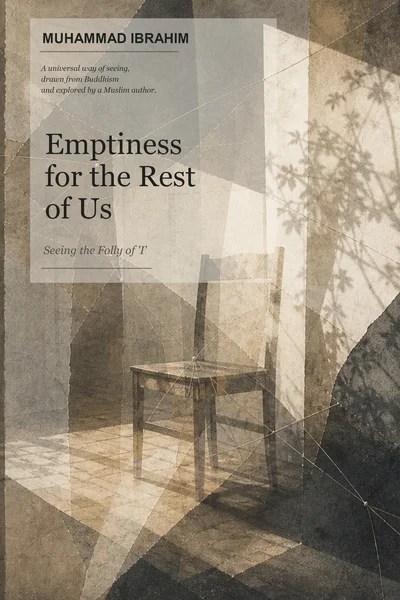
Cover of Emptiness for the Rest of Us by Muhammad Ibrahim, showing an empty meditating robe beneath a moonlit sky.

Featured Book

Emptiness for the Rest of Us

Seeing the Folly of “I”

A universal way of seeing, drawn from Buddhism and explored by a Muslim author.

Read the Book Free

No payment. No registration. No conversion. No new identity required.

What does “emptiness” mean?

Emptiness does not mean that nothing exists. It does not mean that life is meaningless. It does not mean that people, suffering, responsibility, love, faith, or moral duty are unreal.

Nothing—including the self—exists as a completely separate, fixed, and independent thing.

A chair depends on materials, parts, design, labour, language, purpose, and use.

An emotion depends on memory, interpretation, expectation, fatigue, fear, bodily sensation, and circumstance.

A person depends on body, language, ancestry, relationship, culture, memory, habit, hope, grief, and change.

The self is not nothing. But it may not be the solid owner we have imagined. And if the self is not fixed, suffering may not be fixed either.

Why begin with Buddhist emptiness?

Because some traditions have examined certain human questions with unusual depth. Buddhist thought has spent centuries examining: the nature of the self; the causes of suffering; attachment and clinging; dependent existence; perception and mental construction; the relationship between change and freedom; the difference between experience and the stories built around it.

That does not mean wisdom belongs exclusively to Buddhism. It means Buddhism has developed powerful tools for looking at these particular questions. The aim is not to borrow a Buddhist identity. It is not to declare all religions the same. It is not to turn Buddhist teachings into vague universal spirituality. It is to encounter an insight carefully enough that it is allowed to challenge us before we translate it back into what we already know.

Wisdom without conversion

A person should be able to learn from a tradition without pretending to belong to it. A Muslim may learn from Buddhism. A Buddhist may learn from Christianity. A believer may learn from a philosopher. A religious person may learn from science. A skeptic may learn from a sacred text.

To learn from another source is not necessarily to surrender one’s own identity. Nor is it permission to flatten differences. Real learning requires both openness and honesty.

Openness asks:

What truth may be present here?

Honesty asks:

What does this source actually say, and where might I be misunderstanding it?

Wisdom for the Rest of Us exists between those two questions.

Who are “the rest of us”?

Not only scholars. Not only monks, priests, mystics, philosophers, or lifelong practitioners.

The rest of us are people with jobs, families, debts, and aging parents. With uncertain futures, private regrets, old anger, and religious commitments. With doubts, tired bodies, complicated relationships, and unfinished questions. With minds that keep turning every experience into a story about “me.”

The rest of us may never enter a monastery, philosophy department, meditation centre, seminary, or retreat. But we still live with pride, fear, suffering, comparison, change, loss, responsibility, and the need for meaning. Wisdom matters here too. In the office. At home. During conflict. After failure. In prayer. In grief. In the moment before a harsh sentence is spoken. In the small decision not to make everything about ourselves.

The first book

Emptiness for the Rest of Us

Seeing the Folly of “I”

Part One: The Lamp of Inquiry

A Reasoning Approach

The first part uses reasoning to examine whether ordinary things possess independent existence, whether the self can be found as a fixed inner core, how continuity can exist without permanence, why dependence does not mean unreality, how emptiness makes change possible, and why no fixed self does not remove responsibility.

Part Two: The World Before Words

The Direct Approach

The second part becomes more direct. It explores the difference between an experience and the name placed upon it, how the sense of “I” is assembled, the spiritual ego, the urge to turn insight into status, Zen stories, purpose as participation rather than personal significance, and service without self-display.

The movement is from understanding to seeing, and from seeing to living.

Some questions the book explores

The following questions guide the inquiry.

Where is the “I”?

Is it the body? A memory? A thought? An emotion? A name? A life story? A silent observer behind experience? When each possibility is examined, we find movement, relationship, dependence, and change. But where is the separate owner?

Is the witness another hiding place for the self?

It can be useful to notice: “I am aware of this anger. I am not only the anger.” But the mind may then create a subtler identity: “I am the pure observer behind experience.” The book asks whether this observer can be found apart from seeing, hearing, thinking, sensing, and knowing.

Does no fixed self remove responsibility?

No. The practical person remains. A person still keeps promises, protects the body, cares for family, answers to a name, remembers consequences, and takes responsibility for harm. The problem is not the everyday use of “I”. The problem begins when this useful pattern is treated as an independent and permanent master.

Does emptiness make life meaningless?

The argument of the book is the opposite. A wound can heal because it is not fixed. A person can change because identity is not sealed. Repentance is possible because a human being is not permanently identical with the worst thing they have done. Forgiveness is possible because neither the wound nor the wounded identity stands alone. Emptiness is not the destruction of meaning. It is the openness that makes transformation possible.

About the author

My name is Muhammad Ibrahim.

I am a Muslim from Pakistan in my late fifties. I do not write as a Buddhist monk, teacher, formal practitioner, historian, or academic specialist. I write as a reader, a thinker, and a human being who has spent many years examining questions of identity, suffering, belief, fear, purpose, and the burden of being someone.

I have deliberately not translated Buddhist emptiness into familiar Islamic vocabulary. I have not tried to prove that Buddhism and Islam are secretly saying the same thing. I have also not approached Buddhism as a religion to adopt. I approached it as a rigorous source of inquiry into selfhood, perception, clinging, suffering, and change.

My own tradition taught me not to fear wisdom merely because it appears through another voice. But openness does not remove the responsibility to be careful.

This project therefore proceeds with two commitments: to seek wisdom without fear, and to represent its source without dishonesty.

What this platform is\u2014and is not

This is a place for:

  • serious encounters with ideas
  • wisdom crossing cultural and religious boundaries
  • careful reading
  • open inquiry
  • ordinary human application
  • respectful disagreement
  • learning without forced identity
  • questions that remain alive after the page ends

This is not:

  • a Buddhist organisation
  • an interfaith institution
  • a conversion project
  • a claim that all religions teach the same thing
  • a platform for attacking religious belief
  • a collection of motivational quotations
  • a promise of easy enlightenment
  • an attempt to replace scholars, teachers, or living traditions

It is simply a place where a valuable idea can be examined without first asking whether it belongs to “us” or “them”.

Read the book free

The complete book is available through Internet Archive. You can read it online, download it, and share the original edition under its Creative Commons licence.

Read the Book Free

No payment. No registration. No email required.

Contents

Section I — The Lamp of Inquiry

A Reasoning Approach

  1. 1. The Illusion of the Obvious
  2. 2. The Mirage of the “I”
  3. 3. The Canvas of Change

Section II — The World Before Words

The Direct Approach

  1. 4. The Finger and the Moon
  2. 5. Where to Look
  3. 6. The Marrow of Silence
  4. 7. No Mirror to Polish
  5. 8. The Open Life

For reviewers, teachers, reading groups, and interviewers

The book is freely available for serious reading, criticism, and discussion.

I welcome:

  • honest reviews
  • critical responses
  • reading-group discussions
  • podcast conversations
  • interviews
  • university and community dialogues
  • Buddhist responses
  • philosophical responses
  • responses from readers of other religious traditions
  • disagreement offered in good faith

No favourable conclusion is expected. Private correspondence will never be quoted publicly without explicit permission.

Essays and continuing inquiries

The first essays on this platform will continue exploring questions raised by the book:

  • Is the witness another form of the self?
  • Why emptiness does not mean nothingness
  • How anger becomes identity
  • The ego’s spiritual scorecard
  • Why the ego can make a career out of overcoming the ego
  • Purpose as participation rather than significance
  • Can we learn from a religion without becoming its followers?
  • Why I did not translate Buddhist emptiness into Islamic language

Future work will follow the questions wherever they lead. The platform is not committed to one tradition. But it is committed to taking every source seriously enough not to reduce it to a slogan.

A final invitation

The next time you feel praised, criticised, ignored, frightened, ashamed, or compelled to prove yourself, pause for a moment. Notice what has gathered. Body. Feeling. Memory. Interpretation. Fear. Pride. The wish to be seen. The need to defend. Then ask:

Where is the fixed “I” inside all of this?

Do not rush to answer. Look.